

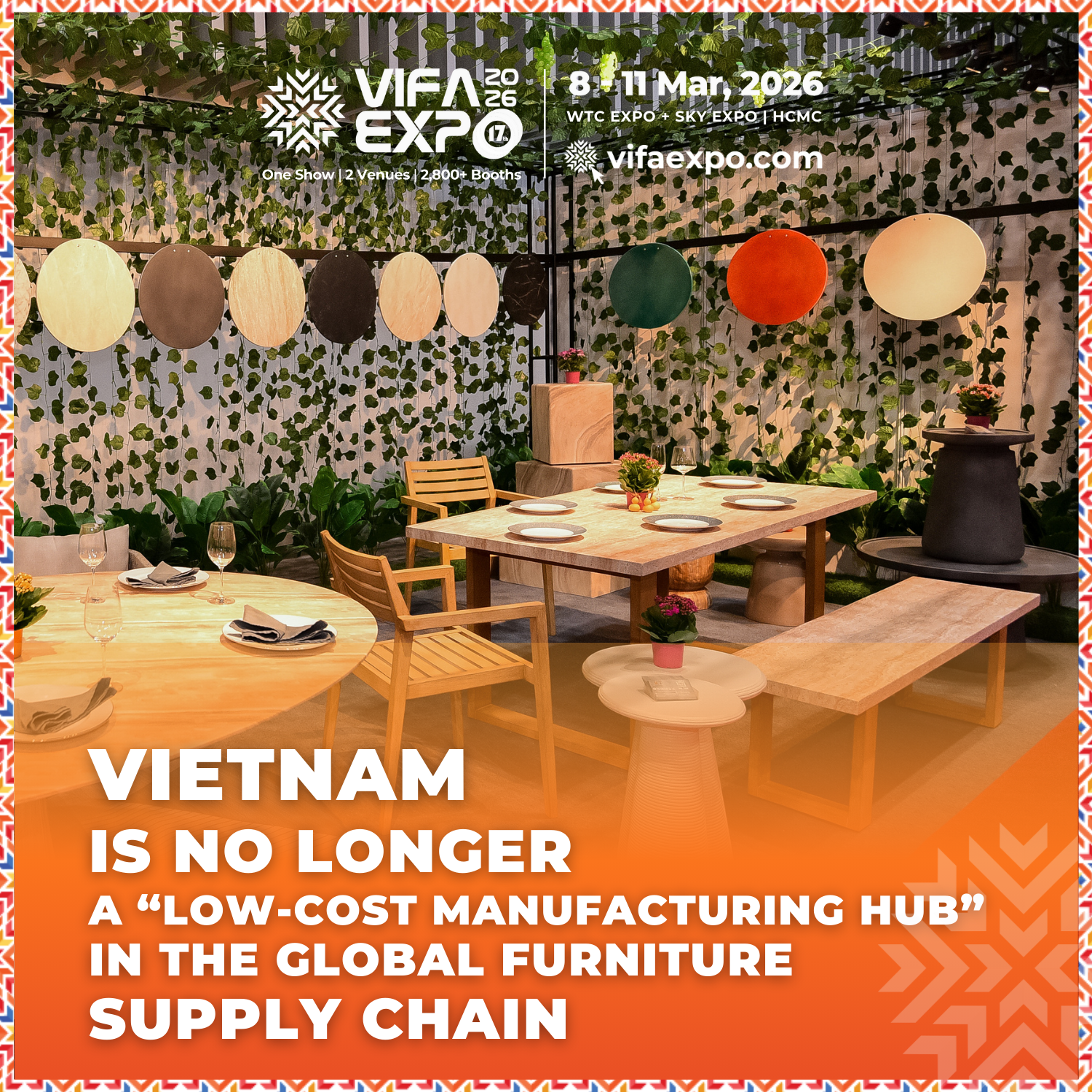
25 Dec Vietnam Is No Longer a “Low-Cost Processing Hub” in the Global Furniture Supply Chain
Vietnam Is No Longer a “Low-Cost Processing Hub” in the Global Furniture Supply Chain
As the global furniture and handicrafts export market undergoes a significant restructuring, Vietnam’s position on the international sourcing map has evolved materially. Buyers—particularly from the United States are no longer prioritizing suppliers based solely on the lowest FOB pricing. Instead, sourcing decisions are increasingly driven by a comprehensive evaluation of operational capability, standards compliance, and long-term supply stability.
A key indicator of Vietnam’s upgraded positioning is the substantial growth in export value to the U.S. market. According to Furniture Today, Vietnam became the largest furniture exporter to the United States in 2023, with export turnover reaching approximately USD 7.76 billion—an increase of nearly 40% compared to the pre-COVID level of USD 5.5 billion. This underscores Vietnam’s expanding role in the global supply chain, not merely as a cost-competitive option, but as a strategic manufacturing partner with scale and execution capability.
From both a policy and international buyer-demand perspective, this trend is increasingly evident. Beyond pricing considerations, buyers are placing greater emphasis on compliance with safety standards, material traceability, and production consistency. Market research indicates that traceability is rapidly becoming a mandatory operating requirement for major export destinations such as the EU and the U.S., compelling suppliers to meet more stringent legal and product compliance standards.

This reality reflects a fundamental shift in how international buyers approach sourcing. The focus has moved beyond low production costs to include long-term operational risk management, the ability to maintain consistent quality across production batches, and transparency in product information. A common counterargument is that “Vietnamese quotations still look inexpensive on a spreadsheet.” However, buyers who concentrate narrowly on low pricing while overlooking operational execution often incur higher downstream costs, including delivery delays, rework, or quality inconsistencies in repeat production.
The evolving sourcing mindset among global buyers clearly indicates that low cost is no longer a sustainable competitive advantage. Instead, operational excellence, standards compliance, and long-term reliability have become the decisive differentiators. For Vietnamese export enterprises, this represents both a challenge and a strategic opportunity to reposition themselves within the global supply chain from contract manufacturers to capable, high-trust production partners.
In this context, internationally standardized trade promotion platforms function as a critical “filter,” enabling buyers to assess suppliers not only through pricing, but through demonstrated capabilities, product offerings, management systems, and market readiness. Accordingly, VIFA EXPO—the largest export-oriented furniture exhibition in Vietnam—continues to serve as a strategic meeting point between Vietnam’s manufacturing and export community and international buyers seeking long-term value partnerships.
Taking place from March 8–11, 2026, VIFA EXPO 2026 – the 17th edition of Vietnam’s largest export promotion exhibition for furniture and handicrafts is expected to feature approximately 2,800 booths across a total exhibition area of 51,000 sqm. The event will be held concurrently at two international-standard exhibition venues in Ho Chi Minh City: WTC EXPO (Binh Duong Ward) and SKY EXPO (Trung My Tay Ward). More than an early-year trade event, VIFA EXPO 2026 will provide a clear reflection of Vietnam’s transformation within the global furniture supply chain.
Register for a booth at VIFA EXPO 2026 today to secure a strategic exhibition location and proactively capture order opportunities for 2026.